
Throughout 2025 and 2026, credit union leaders anticipated a lower interest rate environment on the horizon and started to prepare balance sheet accordingly. However, stubborn inflation has persisted into 2026 and, while cracks have appeared in the labor market, overall unemployment numbers have yet to steal the Fed’s focus away from inflation. Additionally, geopolitical tension in the Middle East has triggered oil and energy price shocks that have especially impacted American consumer confidence and inflation expectations. With that in mind, futures markets have pushed prospects for additional rate cuts well into the future.
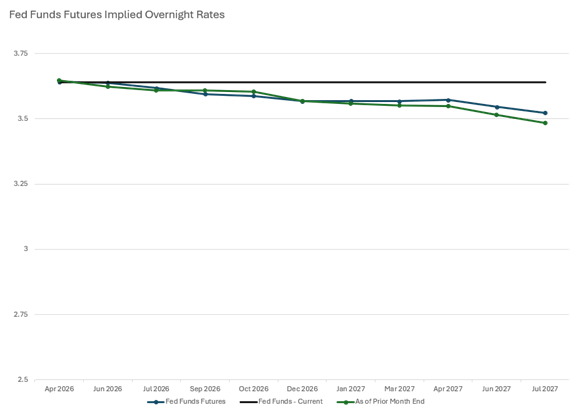
For Asset Liability Management, this means we are shifting focus from a gradually declining interest rate environment to a stagnant rate environment that is higher for longer. Here we examine the critical impacts on key ALM metrics and the strategic adjustments necessary to navigate this new base case. The following analysis reflects general market observations and potential considerations for credit unions.
Net Economic Value in a Stagnant Rate Environment
Net Economic Value, or NEV, is a measure of the long-term valuation of a credit union’s balance sheet. It is calculated as the present value of future asset cashflows minus the present value of future liability cashflows. One of the critical components of the present value calculation is the discount rate, which is the rate of return/expense you could expect from a similar asset/liability under today’s market conditions. A lower discount rate benefits the valuation of assets by increasing the premium but negatively affects the valuation of liabilities by reducing the discount.
Through the latter half of 2024 into 2025, falling rates created an asymmetric benefit as asset valuations rose sharply while liability discounts declined more gradually, lifting credit union NEV ratios. That tailwind has ended and with little to no near-term rate movement expected, NEV may be less influenced by favorable interest rate dynamics. Instead, changes in NEV will primarily reflect balance sheet actions, like loan portfolio quality, investment positioning and deposit cost management.
Three Levers for NEV in a “Higher-for-Longer” Environment
Let’s look at a quick breakdown of these topics:
Credit Quality in the Loan Portfolio
Credit trends in your loan portfolio, from delinquencies and charge-offs, can have a significant impact on the NEV calculation through a mechanism called “credit spread”. If you haven’t already, you can read more about this topic in a previous Accolade blog: The Hidden Cost of DQs: Impact of Credit Spread on Your Credit Union's NEV. With little to no movement in interest rates, the premium or discount applied to loan valuations based on credit quality becomes a dominant factor in NEV calculations. Charge-off and delinquency trends have broadly eased over the past two quarters. However, rising energy prices, a tightening labor market with reduced participation, and record low consumer confidence levels are all warning signs that point to a potential uptick in credit losses depending on economic conditions.
Consider reviewing and stress-testing loan underwriting policies. Ensure your credit union is prepared for a potential deterioration in credit quality and understand which credit stress scenarios cause the biggest headaches to your balance sheet.
Optimizing Investment Yields
The yield curve is normalizing. Just months ago, rates were largely flat across shorter tenors and inverted at longer ones, meaning that investors were not compensated for duration risk. The curve now slopes upward as expected and bond yields have rebounded to over 4.5% for many permissible structures. CD rates also reflect duration premiums across the curve but remain tight to risk-free rates.
If your credit union has excess liquidity relative to loan demand, you may consider deploying excess liquidity into longer-term securities, where appropriate based on your individual risk profile and ALM position. Higher investment yields may improve NEV, though this must be balanced against interest rate risk and overall ALM considerations.
Deposit Portfolio Management
Most credit unions fund their balance sheet at rates significantly below market rates, earning a funding spread on deposits that accounts for much of their profitability. However, deposit rates often lag market movements, creating a period where funding spread widening or tightening can have an outsized impact on overall profitability. With deposits growing faster than loans at most credit unions in 2026, the pressure to hold deposit rates has eased but the pressure to reduce loan rates has increased.
Evaluate your deposit rate positioning. If you have not had to adjust rates downward to match the current market, and liquidity remains robust, there is immediate room to improve margins and improve competitiveness on loan rates. If you choose to maintain higher savings rates as a member benefit, ensure that decision is tied to your strategy for net interest margin goals.
DISCLOSURE: This material is for informational purposes only and represents an assessment of the market and economic environment at a specific point in time and is not intended to be a forecast of future events or a guarantee of future results. Forward-looking statements are subject to certain risks and uncertainties. All models, projections, and analyses are based on assumptions and are for illustrative purposes only. Actual results, performance, or achievements may differ materially from those expressed or implied. Past performance is not indicative of future results.
Accolade Investment Advisory, LLC (“Accolade”) is an SEC-registered investment adviser. Registration does not imply a certain level of skill or training. Services may include both investment advisory and non-advisory consulting, provided under separate agreements.